
A new model of venture building: Why ClimaFii isn’t a traditional accelerator

Many accelerators run on a template. Pick a cohort, run everyone through similar curriculum, same milestones, same pitch-ready endpoint, and hope the diversity of the companies survives the uniformity of the program. ClimaFii Alliance doesn’t work that way, and it’s not a cosmetic difference.
We support companies innovating to build, finance, and deploy productive-use energy and e-mobility solutions in solid value chains, the kind where microenterprises can earn and increase their incomes, sustainably. That mandate alone rules out a single template: the companies we support range from pre-seed distributors with three employees to specialized asset finance platforms doing millions in annual revenue. They sell solar freezers to fish traders in Zambia, finance electric motorcycles in Uganda, set up greenhouse farmer estates linked to solar powered cold storage, and run multi-brand PAYGo platforms across twenty African markets. A standardized curriculum would be the wrong tool for most of them on day one.
So we don’t start with a curriculum. We start with a diagnostic, and the support that follows is built around where a company actually is, not where a template assumes it should be.
Capital alone doesn’t move the needle
Every company we work with has heard a version of the same advice: raise more, deploy more, scale faster. What they haven’t had, consistently, is help with the two things that actually gate growth in productive use energy and electric mobility: go-to-market and end-user finance. These are the places where good businesses stall, and they’re also the places least addressed by capital alone.
Go-to-market in this sector means more than finding new customers. It also means making sure the demand side is organized enough for a productive-use asset to be viable in the first place. A solar freezer is not a product you sell into a vacuum. It needs to sit inside a value chain with organized offtake: a fish supply chain, a cold-storage network for agricultural produce, a corporate buyer relationship, something that gives the microenterprise who owns that freezer a reliable reason and steady income to keep using it. Lake Farms in Zambia makes this concrete: it isn’t just distributing solar freezers, it’s acting as the anchor buyer for the fish those freezers preserve, which is what makes the financing around the freezer bankable in the first place. Koolboks is doing something similar through its corporate channel, with pilots running through Fan Milk, Delifrost, and other offtake partners that give its financed equipment a reason to generate steady use.
End-user finance is the other half, and it’s where most companies in this space get stuck in the same pattern. They raise a small amount of equity, use it to manufacture or acquire assets, deploy those assets to microenterprise customers, and then wait twelve to twenty-four months to get paid back while trying to simultaneously grow the customer base and prove repayment quality. That’s a hard treadmill to get off of without outside help, and it’s the specific problem ClimaFii was built to address.
That wait is the trap. To raise an actual seed round, a company has to show month over month that it’s growing its customer base while simultaneously proving and improving repayment, two things that are hard to do at once on a thin balance sheet. Most companies end up doing far more in-house than they’d choose to, manufacturing, financing, and collecting all themselves, simply out of necessity, because no bank, MFI, or dedicated asset finance company will take on that risk without evidence the company can’t produce without more capital in the first place. That’s the gridlock, and it’s a well-worn pattern in this sector. ClimaFii exists because capital alone doesn’t break it; targeted technical assistance on the financing side does, and that’s the specific problem the program was built to address.
Three patterns, one program
Every company and every market we work in looks different on the surface. Underneath that, we tend to sort productive use energy and e-mobility companies into one of three buckets, and that sorting is one of the most useful tools the Accion and BFA teams have for deciding where to focus hands-on support. The core distinction comes down to the main asset being financed: whether it’s deployed to individual customers at all, and, if it is, whether the company wants to run that financing itself as a specialty or would rather focus on its core business and partner with a lender.
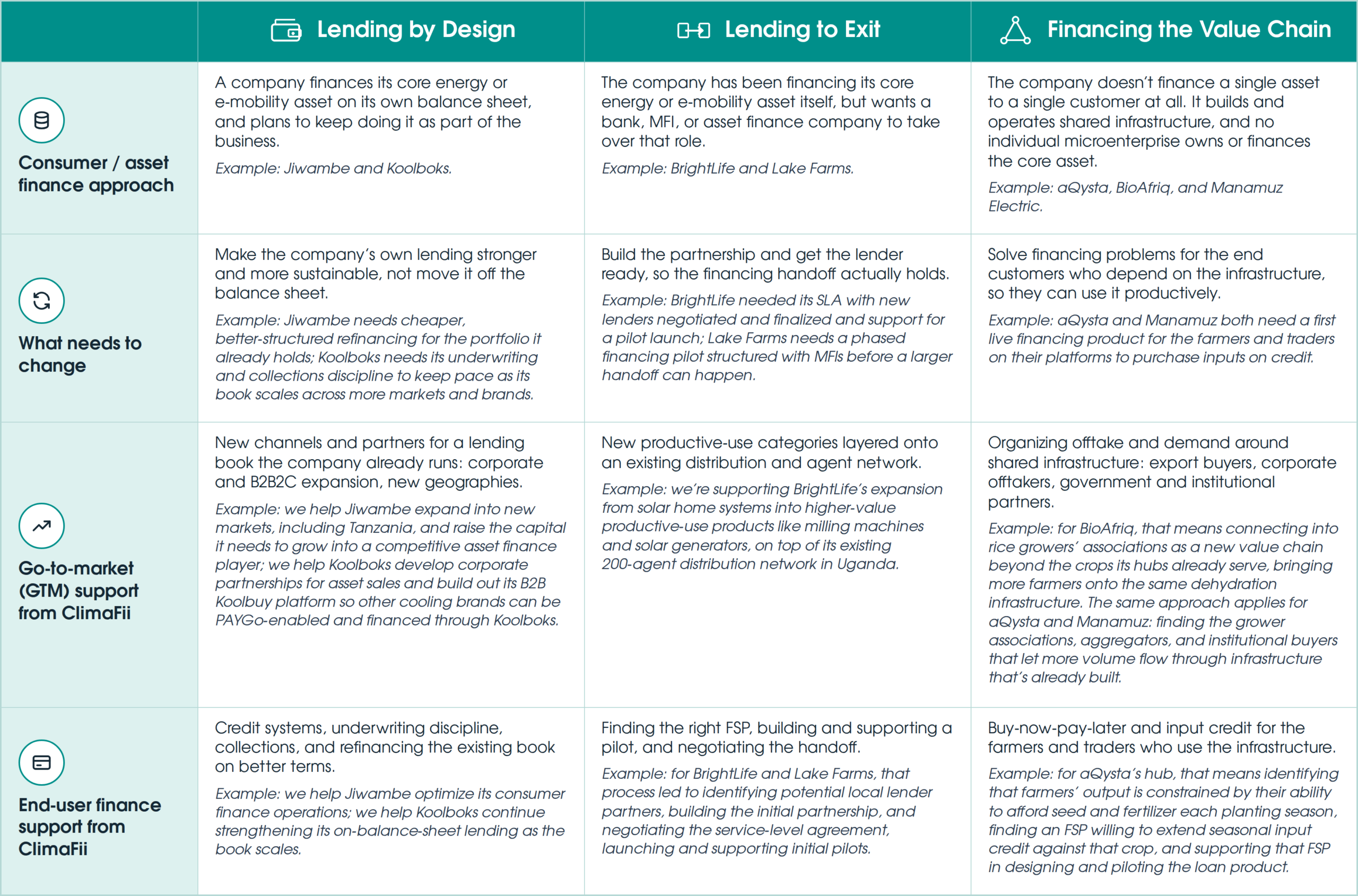
- Lending by Design – The first is companies financing their core asset on their own balance sheet, and intending to keep doing it. That’s their bread and butter, not a stopgap. Jiwambe, an electric motorcycle asset finance company in Kenya, and Koolboks both sit here. The work for these companies is about making that lending better: credit systems, underwriting discipline, collections, and often helping them refinance on better terms rather than helping them exit the model altogether.
- Lending to Exit – The second is companies that have been financing their core asset themselves but want out of that role. BrightLife in Uganda and Lake Farms in Zambia are the examples. The work here is building the partnership that lets them exit: finding the right bank, MFI, or asset finance company, and supporting that institution directly so the handoff actually holds. BrightLife’s relationship with the lenders FINCA Uganda and In24, and Lake Farms’ work with MFIs are both live examples of this in progress.
- Financing the Value Chain – The third model is different in kind, not just degree. These are companies that don’t have a single asset to finance to a single customer at all. They’re building and operating larger shared infrastructure, a charging station, an agri-processing hub, a walk-in cold room, a large renewable-powered drying or dehydration facility, and no individual microenterprise owns or finances that infrastructure directly. For these companies, end-user finance isn’t about financing the big asset. It’s about solving financing problems for the end customers who depend on that infrastructure, so they can produce more, consistently, and be brought into an organized value chain around it: buy-now-pay-later for fish inventory, credit for agri inputs like seed and fertilizer, the working capital that lets a farmer or trader actually use shared infrastructure at the volume that makes it worthwhile.
Capital alone solves none of these three problems, and treating them as one problem is exactly the mistake a generic accelerator curriculum makes. Each pattern needs a different, specific kind of technical assistance, delivered by people who’ve actually done that kind of work before, and even the go-to-market partners worth introducing differ by pattern: a bank or MFI for the first two, an offtaker or input supplier for the third. Without that calibration, a company’s path to scale stalls, and the climate and livelihoods outcomes riding on it stall with it.
Why BFA Global and Accion, work together
Here’s the piece that we think is genuinely uncommon in this space, and that most of our origin story as an alliance is built around. BFA Global and Accion run ClimaFii jointly, with a combined team of roughly thirty professionals across Sub-Saharan Africa, and the two organizations are not splitting the work by category so much as splitting it by side of the same transaction.
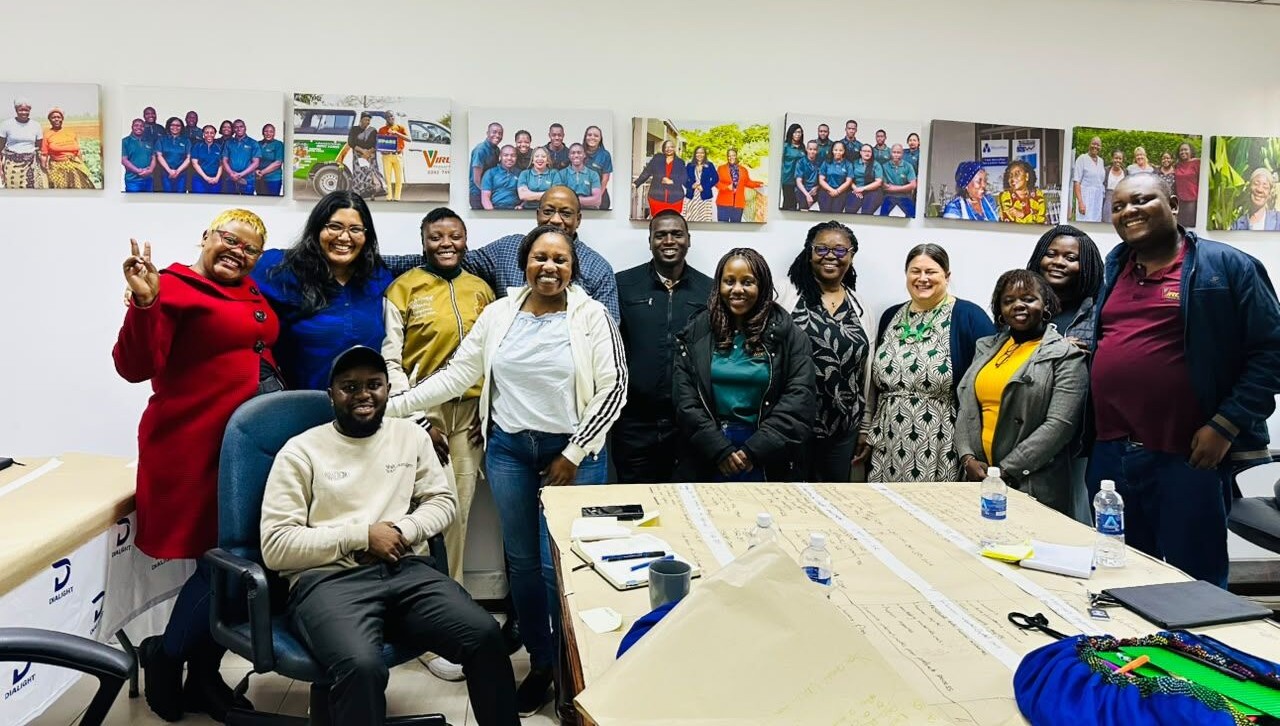
BFA Global’s team is startup people: former founders and venture builders with almost a decade of experience taking more than two hundred companies through accelerators, incubators, and bespoke venture-building engagements across Africa. That’s the expertise that goes into go-to-market, product, partnerships, and the operational muscle a startup needs to grow. Accion’s team has spent decades on the other side of that transaction: financial services, credit risk management, and technical assistance delivered directly to lenders, MFIs, and banks. That’s a different discipline entirely, and it’s not one most startup-focused venture builders have in-house, and it’s not one most financial-inclusion TA providers point at startups.
What’s unusual is that we apply both, at the same time, to the same deal. Most technical assistance in this space is delivered to one side of the table. An accelerator helps the startup. A financial-inclusion program helps the lender. Rarely does the same team work both sides of the same partnership simultaneously, which means a lot of potential deals stall in the gap between a startup that isn’t quite investable to a lender and a lender that doesn’t understand the startup’s risk profile well enough to say yes. ClimaFii was built specifically to close that gap, with one BFA lead and one Accion lead assigned to each company so both sides of the conversation happen in parallel rather than getting handed off.
How it actually runs
The engagement doesn’t start with a workshop schedule. It starts with a joint scope of work, built from diagnostics across go-to-market, end-user finance, and fundraising, that the company signs off on before anything else happens. For BrightLife, that meant diagnostic deep dives before a statement of work was finalized with the company. For Koolboks, it meant multiple diagnostic sessions across sales, commercial, and credit before a Sprint 0 scope was agreed. Sometimes the diagnostic tells us where not to intervene. For some companies, customer financing simply isn’t what’s holding the business back: the route to market already works, customers are already buying, or the model is service-led, so no one needs to finance an asset. Rather than force a financing workstream onto those businesses, we redirect the effort to companies where financing is clearly limiting growth. A curriculum-led accelerator would have run them all through the same program.
We’ve also learned, the hard way in places, that the intensity of support has to be calibrated to a company’s stage, not applied uniformly. Early-stage companies often need deep, embedded support where a venture lead is stepping into drafting investor materials or building data tools and financial trackers directly. More mature companies need something lighter and more strategic. We now think about this in three tiers, Emerging, Growth, and Acceleration, rather than leaving the calibration to individual judgment call by call.
One other internal lesson worth stating plainly, because it shapes how the model actually functions day to day: go-to-market and end-user finance can’t be cleanly separated in practice, even though BFA leans in on one and Accion leans in on the other. Pricing, channel, and financing decisions are tangled together, so both leads stay present in each other’s conversations rather than working in separate lanes. Where we tried to scope the workstreams differently, it created gaps.
What this looks like in practice
What this looks like in practice varies by pattern. For BrightLife, a distributed renewable energy company running over two hundred community sales agents across twenty-two locations in Uganda, it meant BFA and Accion working both sides of the same deal at once: improved business practices and new tools across go-to-market and end-user finance, and direct support negotiating BrightLife’s service level agreement with its MFI and asset finco partners. For Koolboks, which finances its PAYGo refrigeration customers directly on its own balance sheet, the work has been about making that lending better: building a new credit playbook now in active use by its credit team, developing tools to improve lead conversion, leaning into B2B partnership development with nationwide corporates and a gender intentionality assessment that fed directly into its growth strategy. For Lake Farms, a Zambian company that has been financing solar freezers to fishing communities out of necessity rather than choice, the work has been building its way out of that role, with Accion supporting a phased financing structure, building a partnership with Lupiya Microfinance that would let Lupiya take on an initial batch of freezers, building the systems and processes to support the partnership, and testing repayment performance before a larger handoff.
Why this matters beyond the portfolio
The throughline across all three examples is the same: capital unlocks deployment, but it doesn’t unlock the two things that determine whether that deployment survives contact with reality: a market organized enough for the asset to be used productively, and a financing structure the end customer and the lender both trust. That’s a go-to-market problem and an end-user finance problem, and solving both at once, for the same company, with teams that have deep, separate expertise in each, is what we think makes this venture-building model different from a cohort-based accelerator and better suited to what productive-use energy and electric mobility companies in Africa actually need right now.