Why we invested in distributed energy: Expanding access and productivity across Africa’s enterprises

Reliable, affordable energy is one of the most critical enablers of productivity for micro- and small enterprises (MSEs) across Africa. Yet today, around 600 million Africans – nearly half the continent’s population – still lack reliable access to electricity. In fact, sub-Saharan Africa accounts for about 85% of the global population without access.
For those connected to the grid, energy supply remains precarious. Around 78% of firms in Africa reported experiencing power outages in the past year, and 41% identified electricity as a major constraint to their business operations, more than any other region globally. On average, many businesses experience power interruptions, lasting more than 50 hours per month, which can amount to roughly 25 lost working days per year.
The cost implications for businesses are significant; outages reduce productivity, force reliance on expensive diesel generators or other backup solutions, increase operating costs, and reduce competitiveness. For small enterprises like salons, tailors, shops, food vendors, and other MSEs, these disruptions can hinder profitability, growth trajectories, and even survival.
Distributed energy systems, whether decentralized solar installations, shared rooftop solar for markets/business clusters, or professional installation networks, offer a powerful alternative. They reduce operating costs, enhance reliability, support cleaner growth, and unlock business models that make clean energy accessible to enterprises powering everyday economic activity.
This is why the ClimaFii Alliance has invested in Instollar and ICE Solar, two companies demonstrating scalable, inclusive models in the distributed energy sector. Though operating in different segments within Nigeria, both are redefining how enterprises access reliable power and how clean energy firms scale high-quality, affordable service delivery.
Powering businesses through distributed energy
Instollar addresses a key bottleneck: the shortage of reliable, skilled solar technicians. Launched in 2022 by a women-founded team, Instollar connects solar developers with a vetted network of 1,400+ HSE-certified installers, enabling fast, high-quality deployment. The platform has already completed 2,800+ installations, helping firms cut installation costs by 30–40%, while boosting technician income by up to 25%.
This model enables clean-energy companies to scale operations faster and more affordably. With partnerships across leading solar developers and Original Equipment Manufacturers (OEMs), Instollar is now gearing up for expansion into East Africa and Francophone West Africa, offering the potential to accelerate decentralized, affordable solar access across the continent.
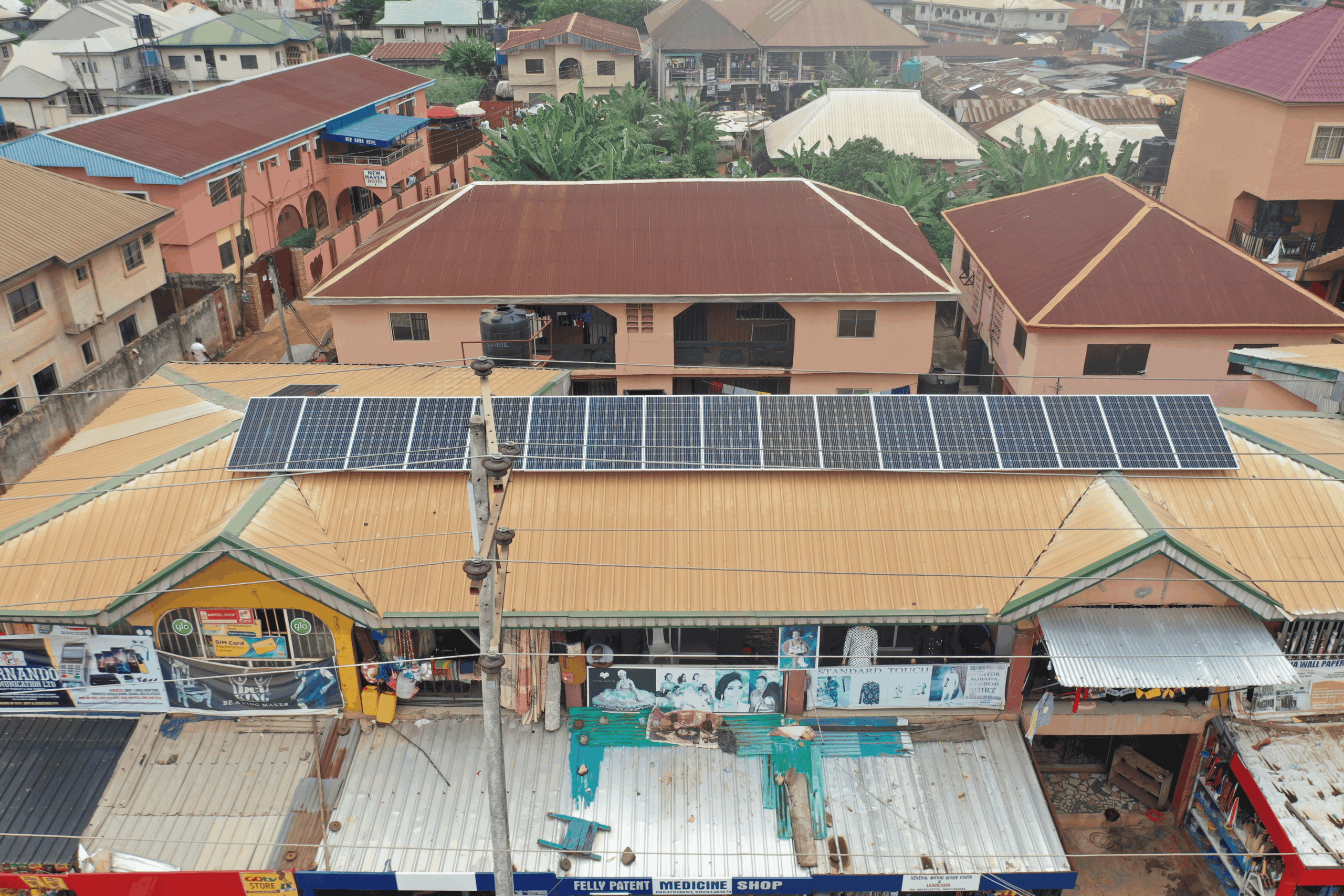
ICE Solar, on the other hand targets peri-urban micro- and small enterprises such as salons, tailors, and food vendors in Nigeria’s dense urban markets, where grid supply is unreliable and generator use is common. The company develops distributed solar systems for commercial plazas, powering multiple businesses through centralized rooftop installations.
By aggregating demand, ICE Solar delivers more reliable, lower-cost power than standalone solutions. Through smart metering, energy-as-a-service contracts, and flexible billing, it removes upfront costs enabling businesses to transition from petrol generators to clean energy. This reduces energy costs, improves reliability, and helps businesses operate more consistently, while making commercial centers more attractive and stable for both tenants and landlords. ICE Solar has deployed over 100 kWp across multiple sites, serving nearly 200 microbusinesses, and is scaling with a 6 MWp pipeline that could reach over 1000+ businesses.
Together, Instollar and ICE Solar illustrate the transformative potential of distributed energy to unlock productivity, reduce emissions, and support enterprise growth at scale across Africa.
Tackling the financing gap
Scaling distributed energy across Africa requires more than vision and demand; it needs capital. Yet financing remains a significant barrier. According to a recent analysis, new funding for electricity access in sub-Saharan Africa remains far below what’s required for universal access.
At ClimaFii, we support companies like Instollar and ICE Solar to bridge this financing gap. For Instollar, we helped secure catalytic funding through a pre-seed round and supported the development of internal systems to track impact metrics (jobs created, income uplift, GHG savings). This kind of capital and support helps the business scale its installer network, expand into new regions, and build a robust platform that can support a continent-wide clean energy transition.
For ICE Solar, our emphasis has been on readying the company for future capital, refining their investor decks, helping them map potential grant-making and early-stage investors, and strengthening their leadership and operations through executive coaching. These steps increase ICE Solar’s credibility and preparedness for funding, while building the operational backbone that will translate capital into scaled impact.
By investing early and building financial and operational readiness, ClimaFii helps distributed energy companies move from promising pilots to scalable, investable ventures, unlocking the pathway for broader finance flows into Africa’s clean energy future.
Beyond capital: Building systems, talent & operations for scale
Capital alone isn’t enough. To deliver distributed energy sustainably and at scale, companies also need quality systems, skilled talent, and consistent operations.
For Instollar, we helped the company deepen its focus on inclusive workforce development. Through the “InstallHER” initiative, we co-developed a concept note to replicate their women-focused training-to-employment model beyond Nigeria, including in Kenya and other East African countries. Supported by gender-focused technical assistance and business development, this initiative aims to increase female participation in clean energy jobs, creating a more equitable and diversified installer workforce while improving service delivery standards.
We also worked on strengthening Instollar’s B2B sales functions, supporting the hire of a Business Development Lead, building a proper sales pipeline (200+ cleantech companies), designing CRM frameworks, and coaching the team on conversion tracking and partnerships.
For ICE Solar, we worked on improving operational systems: reviewing their technology platform for installation workflow and operational data management, recommending a more robust inventory management system (moving beyond spreadsheets), and helping structure customer service manuals to standardize support and troubleshooting. These investments help ICE Solar scale operations consistently, improve service quality, and lay the groundwork for durable growth.
Beyond that, we supported ICE Solar in preparing for embedded finance opportunities, researching their portfolio to understand how financial products could be layered on top of solar services, strengthening their investor pitch, and helping leadership feel equipped to make strategic decisions.
A cleaner, more reliable, and inclusive energy future
Distributed energy is more than a technology solution; it’s a pathway to higher earnings, more resilient enterprises, and cleaner growth across African economies. By making reliable solar power accessible to both the companies that deploy systems and the microenterprises that depend on energy for daily operations, distributed energy unlocks productivity and supports long-term climate resilience.
Scaling this transformation will require collaboration across investors, financiers, implementers, and policymakers and a commitment to building not just power systems, but the people and processes that sustain them. If you’re a funder exploring the intersection of climate, inclusion, and enterprise, a financial institution looking to support high-impact energy investments, or a partner building infrastructure for clean energy, we’d love to connect.
![[Press Release] Shell Foundation and Accion open applications for ClimaFii Alliance second cohort](https://bfaglobal.com/wp-content/uploads/2025/12/Songa-Trikes-450x250.png)