The inexperienced manager problem that’s weighing on emerging market businesses

Fifteen years ago, when I was the managing director of Digital Divide Data Kenya, which provided outsourced services to US companies, we consistently struggled to meet the productivity standards set by our competitors in the Philippines and India. Setting costs aside, we simply could not produce the same number of units, at the same quality, as our competitors.
We quickly identified one reason: the lack of a management cadre that knew what they were doing. Team leaders, floor managers, and operations leads were generally in their first management roles, either promoted from the floor or coming from other industries. To remedy this, we hired managers from countries with established Business Process Outsourcing (BPO) industries, but that wasn’t a magic bullet. It took years of cultural and process changes to build up both the quality and volume of our output.
The BPO sector was new then and has since grown a generation of managers and now meets international productivity standards. That experience gave me food for thought. We know that productivity in the SME sector across emerging markets is low, often a fraction of that of comparable businesses in developed countries. McKinsey found that Micro, Small and Medium Enterprises (MSMEs) in emerging markets reach only 24% of the productivity of large companies, compared to 60% productivity of their larger counterparts in advanced economies. Many reasons are cited, including limited access to intangible capital such as technology, restricted access to international markets, and constrained financial resources. But there is another reason that receives less attention: the inexperienced entrepreneur and the management layers beneath them.
At every level, there are fewer experienced people above you that you can learn from. When you also factor in the rapid increase in education and economic growth, you can see the number of mentors, experienced managers, and advisors above each person is vanishingly small.

Though this problem is structural in Africa, it’s surprisingly not that different in India, as this article from Goodcapital indicates: micro and small-scale entrepreneurs across the developing world are trying to do everything.
How do we get around this problem? One method is just to wait, as we did in the Kenya BPO sector. Eventually, there are enough managers, and of course, everyone is learning. So this isn’t an endless cycle, but it is a slow one.
Another method is to accelerate learning. One way is through franchising, which provides inexperienced entrepreneurs and managers with a blueprint for implementing a specific business model. This really works in the US, with the franchising industry supporting 8.8 million jobs and accounting for 3% of the GDP, according to the 2025 Franchising Economic Outlook. But it hasn’t worked as well in emerging markets outside the fast-food sector. Most franchises require an unachievable investment of capital and may need a higher level of customer income to be sustainable. The business model may also depend on local contexts. Nonetheless, a few are succeeding.
Another way to accelerate learning is to increase the reach of experienced people in business operations such as finance, HR, legal, and operations. Due to scarcity, these people are generally too expensive for new and small businesses to hire. Programs that match experienced leaders with companies have been tested in multiple countries with promising results, but so far, these have failed to reach companies at scale. In addition, there still remains a shortage of experienced middle management needed to implement the systems and processes created by these senior leaders.
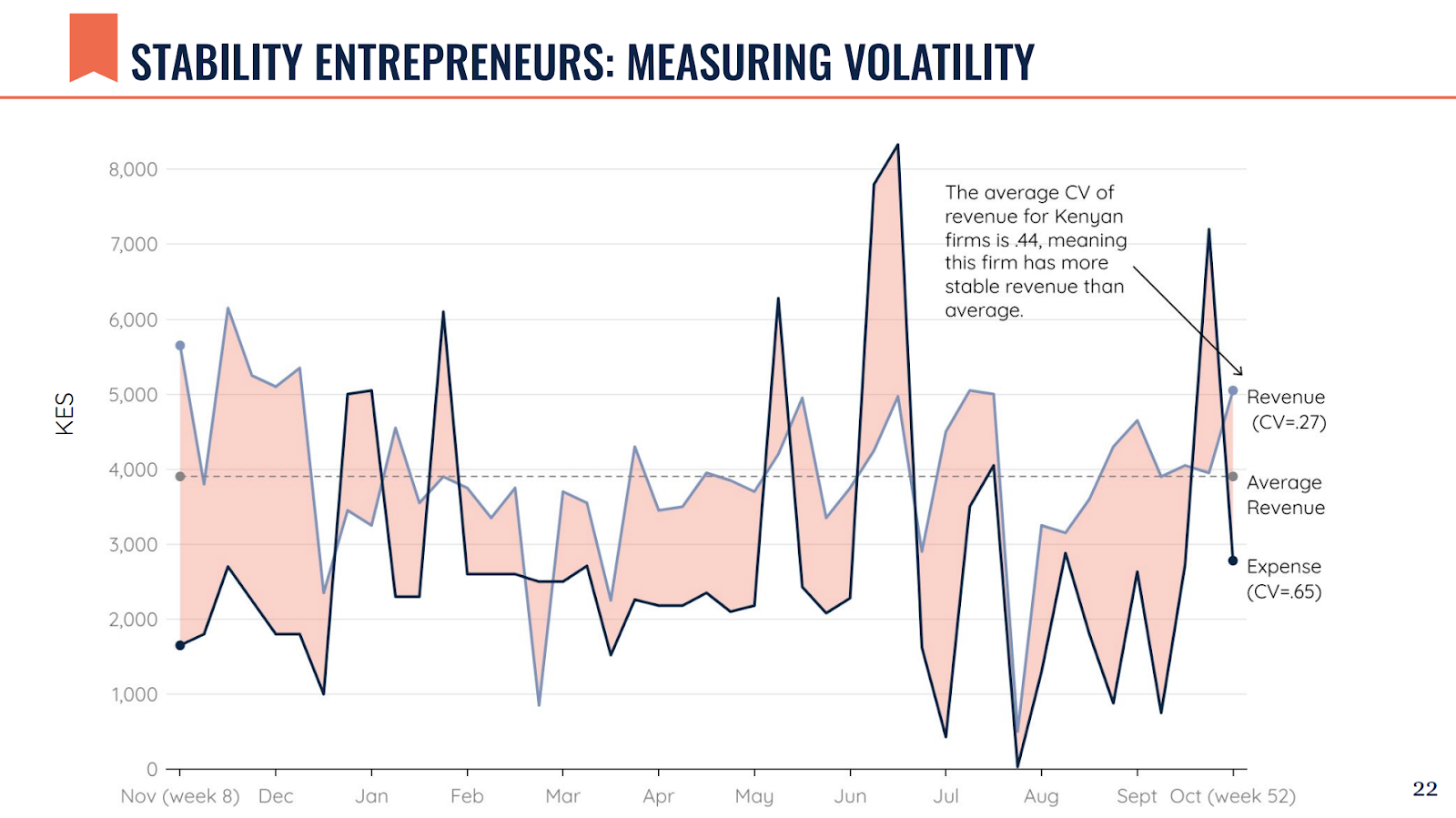
Yet another way is for successful businesses to replicate themselves. Paradoxically, successful entrepreneurs in emerging markets tend to do the opposite: someone who is successful in their hair salon buys a motorbike taxi. They’re successful with the taxi, so they start a chip shop. They’re successful at the chip shop, so they start farming cabbages. This doesn’t build their sector-specific learning or leverage economies of scale. In their study, FSD Kenya notes that this behavior is due to the high-risk environment in which each business operates and helps smooth the extreme volatility in income experienced by most SMEs. Similarly, the graph below from FSD Kenya’s Small Firm Diaries shows how revenue fluctuates, helping to explain why many entrepreneurs choose to spread risk across different businesses rather than expand just one.
As urban centers grow, we are starting to see a move away from this extreme diversification toward the development of small chains of stores, creating expanding store networks rather than standalone businesses. A 2025 press release by Vivo Energy Kenya notes the opening of its 336th Shell service station in Nairobi, describing how the site includes established brands like Java House, Goodlife Pharmacy and Purpink Gifts all in one location. This kind of clustering shows how recognizable retailers are expanding across multiple sites. It suggests there may be an opportunity to support smaller shop owners in a similar way, through training and supporting interventions (including finance) to help them open additional branches and grow into small chains themselves.
Small operators can also learn through value chain training and investment, especially by exporters and international companies that meet international standards. This can involve a lot of trial and error. It is further complicated by the supply chains of larger manufacturers, which continue to rely heavily on imported intermediate products across many countries and industries. Participating in value chain training offers entrepreneurs and managers hands-on exposure. These experiences act as practical learning platforms, helping them pick up skills in quality control, inventory management and supplier coordination. Scaling these skills could be better supported by government-backed manufacturing clusters or production hubs, as seen in China and India. A study on global value chain linkages finds that structured government support and cluster development in China, along with targeted SME integration programs in India, have enabled managers to build competence and grow their businesses more confidently. With the right support, similar approaches could be successfully replicated in other markets as well.
Of course, there’s always education, training, skilling, and self-learning. Ambitious entrepreneurs are always seeking new information and ways of doing things. But they may be hard to implement without the company culture being supportive. When my company, DDD, undertook ISO certification training, one of the big takeaways for managers who had been promoted from the production floor was that management itself is a discipline that requires learning and has tried-and-tested best practices.
All these approaches are still ongoing, with some successes, but not the scale and speed we need to meet the aspirations of the African population bulge. So we’re excited about the possibility of AI to enhance the capabilities of middle management. Rather than replacing the middle manager, an AI could assist them in understanding their context and making the right decisions. Indeed, this could relax a major constraint on business growth and improve productivity across the sector. Within the Jobtech Alliance cohort, platforms like Opareta, Mwingi, and Afriwork are using digital tools and semi‑automated analytics to give small business operators practical ways to make better decisions, from hiring and assigning tasks to monitoring performance, helping them run their businesses more efficiently.
One challenge is going to be whether these AI advisors really understand the emerging market context with its high informality, risk, and opportunity, coupled with low skills, data and infrastructure – the very things that make AI tools more enticing. As we develop investment theses for an upcoming startup accelerator for emerging markets, BFA Global, Jobtech Alliance, and the Alliance for Inclusive AI are going to specifically look for companies that provide solutions to these issues.