What it really takes to increase women’s incomes: Introducing the five domains
Over the past two years, BFA Global’s Women’s Economic Empowerment (WEE) team has partnered with 11 enterprises across Kenya through the Opportunity Leads Umbrella Fund – a program that aimed to understand what stands between women micro-entrepreneurs and a sustainable income, and what it takes to remove these obstacles. We started with a simple question: What does it really take to increase incomes for low-income women? Not in theory but in practice, and not in an ideal future but where women micro-entrepreneurs and the enterprises are now.
Initially, we set out to map a pathway – a clear sequence of steps for women micro-entrepreneurs to improve their livelihoods. However, from short engagements to longer pilots, with enterprises spanning social commerce, community health, domestic work, fisheries and agriculture, we saw a different pattern emerging. Income gains did not follow a linear progression, but instead depended on a set of interconnected forces working together.
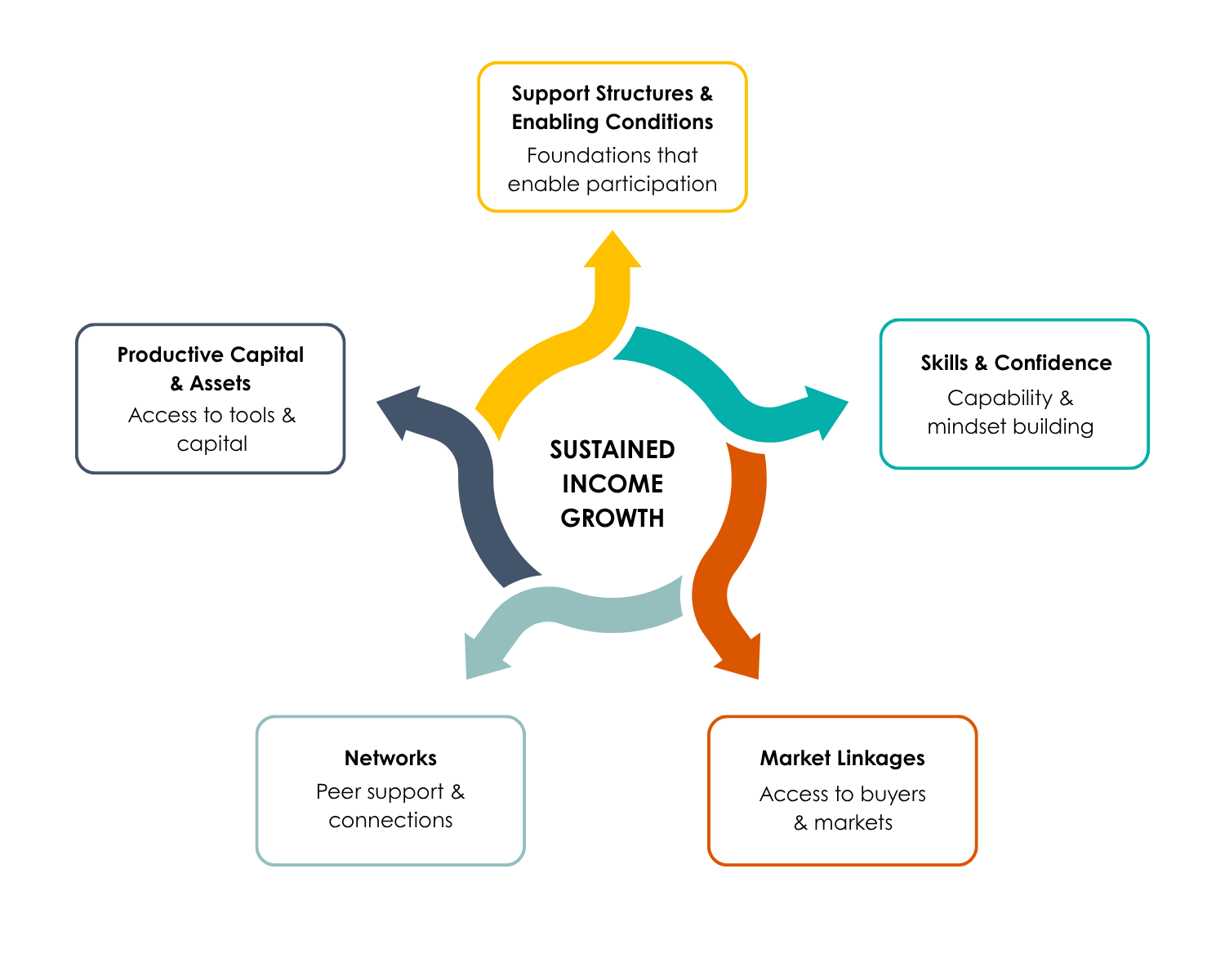
Through experimentation, landscape research, focus groups, interviews, and surveys, we identified five interconnected domains that together increased the incomes of low-income women micro-entrepreneurs. Less a checklist and more a set of reinforcing conditions, these domains – when aligned – significantly increased the likelihood that women micro-entrepreneurs could convert opportunity into sustained income growth.
And succeed they did. Across the Opportunity Leads Umbrella Fund, women working with our enterprise partners saw an average income increase of 49%, equivalent to an additional $85 a month, across almost 1,800 women.
-
Support structures
Hypothesis: Income growth begins not with opportunity, but with support structures that make economic participation possible, including education, social norms, time, and childcare responsibilities.
One of our partners, In Motion Delivery, wanted to support more women micro-entrepreneurs to sell products through social media – a straightforward opportunity to expand reach, increase sales, and boost income. But a practical problem emerged: online selling required male logistics riders to collect goods from women’s homes, which in several cases created household tension. Spouses and community members grew uncomfortable with the repeated presence of male riders. In response, In Motion redesigned the delivery model, introducing local drop-off hubs and storage solutions (“rent-a-shelf”) that allowed women to leave their products in a neutral location, removing friction without losing the opportunity. This operational adjustment unlocked income opportunities for women who would otherwise have been shut out.
In other cases, spouses pushed back against their wives working when earnings were modest and did not yet justify outsourcing childcare or household responsibilities. But as women earned more, attitudes changed. When the value became visible, household approval followed. Norms weren’t fixed, they just shifted with economic returns.
These examples illustrate what we mean by support structures. Time availability, access to childcare, household approval, mobility, infrastructure, and community norms often determine who can participate in the economy. These conditions are dynamic and deeply contextual.
While enterprises don’t control these dynamics, they can design around them. Flexible models, local infrastructure, intentional segmentation, and value propositions that make it worthwhile for women to invest their time, can open doors that would otherwise stay closed. Without them, women micro-entrepreneurs are locked out from income opportunities before they can even begin.
-
Skills and confidence
Hypothesis: Skills generate income when they build both capability and confidence, but only when other domains create the conditions to apply them.
Entrepreneurship training has a mixed track record with low-income women – not because the skills aren’t useful, but because other barriers get in the way, like lack of access to markets, capital, or even time. This has meant that technical skills training often fails to convert into higher incomes. We were initially skeptical for the same reason, concerned that women micro-entrepreneurs would invest their already limited time and resources without any payoff.
However, across our pilots, we observed that initiatives that skipped skills training struggled to gain traction, even when they responded directly to what women said they needed. Done well, skills training played a dual role: it shortened the path to higher income and shifted the behaviors and mindsets that contributed to longer-term success.
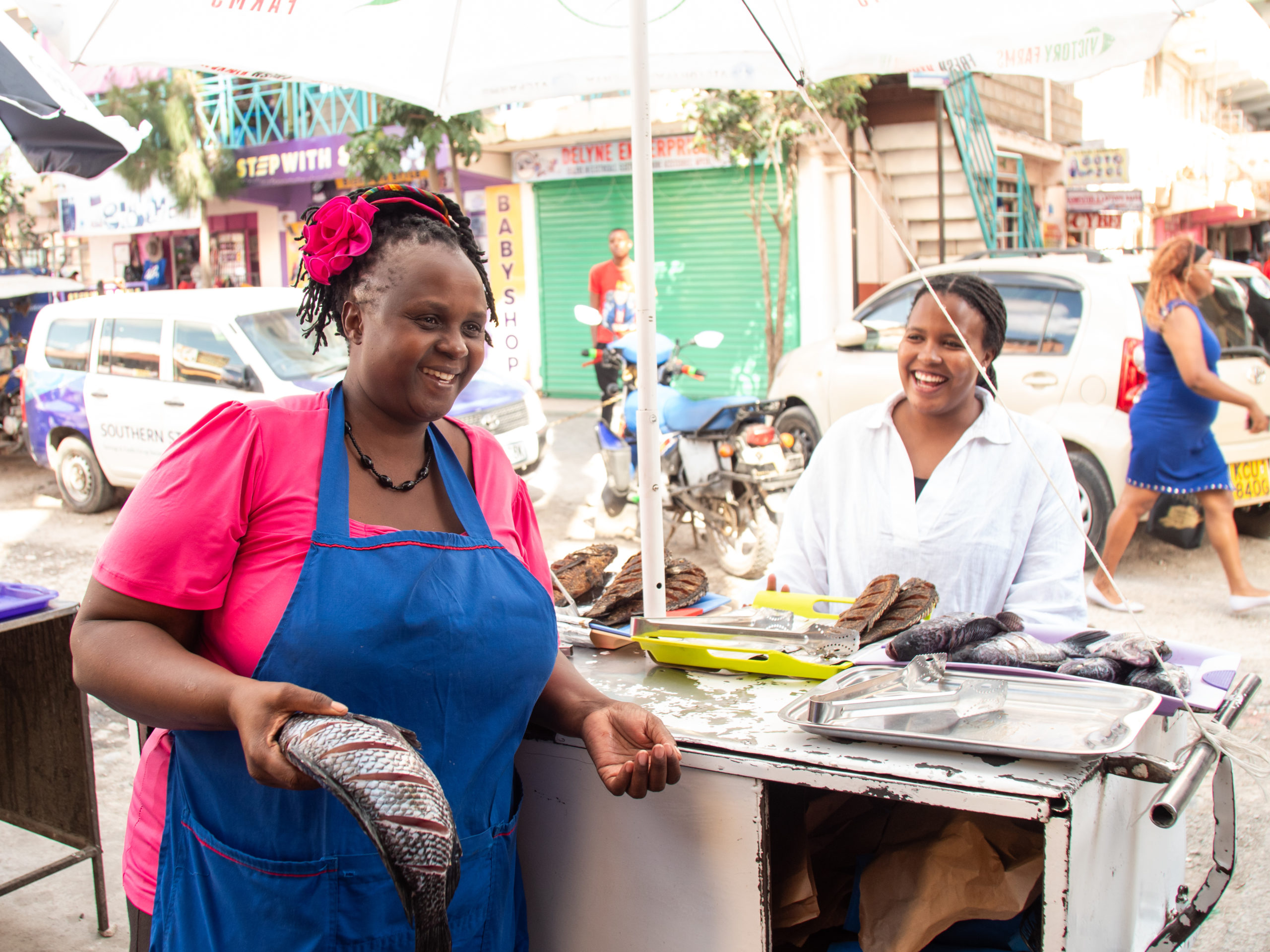
At Victory Farms, the goal was to support women micro-entrepreneurs who were new to fish selling – a crowded, competitive market where mastering the basics isn’t enough to stand out. Mentors – experienced fish sellers – provided hands-on guidance on the things only experience can teach: keeping work areas clean and visible to passing customers, displaying fish attractively, and engaging buyers with confidence. These small adjustments enabled them to stand apart from their competitors.
Skills training also introduced habits that outlasted the training itself. Healthy Entrepreneurs gave women a simple system: physical boxes to separate income into reinvestment, savings, and spending. The boxes eventually fell away, but the habit stuck. When credit was introduced later, default rates stayed below 3%. Women micro-entrepreneurs had already internalized how to manage cash flow.
The shifts in mindset were harder to predict. We had assumed that attitudes toward growth were relatively fixed, with women micro-entrepreneurs sorted into those worth investing in and those just getting by. But once skills were introduced, that line blurred. Women who had been categorized as “survivalists” made real gains. Some said that simply being selected for training changed how they saw themselves. Capability and ambition, it turned out, weren’t always fixed traits. They moved together.
Still, skills training alone is a dead end. Without a clear pathway to income, training uses women’s time without converting it into earnings. In this blog, we go deeper into what makes skills-building productive and the conditions that need to be in place for it to be meaningful.
-
Networks
Hypothesis: Women often rely heavily on peer networks, particularly where formal access is constrained. They provide both social support and an informal economic infrastructure enabling women to borrow small amounts of working capital, share or redistribute stock, refer customers, exchange market information, and support each other through challenges.
In many cases, these groups already exist. Women commonly organize through savings groups or community networks built on trust and shared experience. For example, community health entrepreneurs organically formed groups without the involvement of Healthy Entrepreneurs. They used these groups not only for savings, investment, and social support, but also to manage their businesses, redistribute excess stock, meet increased demand, and support each other. For enterprises, there is an opportunity to strengthen and learn from peer networks, using insights to design solutions such as group-based credit or supply models that align with how women already operate.
Enterprises can also catalyze new networks and groups. Through In Motion’s cohort-based training, women micro-entrepreneurs were initially grouped for learning and information sharing, but these connections evolved into active business networks. Members collaborated to fulfill orders, shared customers, and increased each other’s visibility on social media, often with minimal intervention from the program. While In Motion helped build initial trust, it was the ongoing value of these interactions that sustained the networks after the program ended.
-
Productive capital and assets
Hypothesis: Access to credit alone doesn’t drive income growth. Real impact depends on when, how, and to whom it is provided.
Across our pilots, women micro-entrepreneurs consistently cited capital as a key constraint. This is not unique to women, but it is more pronounced due to their limited access to formal financial services. What became clear, however, is that misaligned capital can be just as limiting as no capital at all.
At Healthy Entrepreneurs, credit uptake and outcomes varied significantly by experience. More seasoned community health entrepreneurs used credit effectively and saw clear value, while newer entrants, despite stating that capital was a key need, were more likely to churn, even when offered zero-interest terms. The issue was not access to credit, but its timing and their readiness. Capital introduced before the value proposition was clear, or before women’s enterprises had the systems to absorb it, proved far less effective.
A similar pattern emerged with Victory Farms. When credit was offered broadly, lower-volume sellers, who were more price sensitive and less embedded in the system, were more likely to churn from Victory Farms when cheaper alternatives emerged and they defaulted on their loans. In contrast, higher-volume sellers, who had more stable demand and stronger business systems, repeatedly took up and repaid loans, finding the structure well-suited to their needs. Participating financial service providers then changed their eligibility criteria to suit only these sellers who were considered less risky.
These examples highlight the importance of segmentation. Different women micro-entrepreneurs require different forms of capital at different stages of their journey. While all need capital to grow, not all are equally ready for commercial financial products. This creates a role for enterprises to identify who to serve with which type of capital, and when.
It also reveals a gap that philanthropic or blended capital can help fill. Lower-income or earlier-stage entrepreneurs may require de-risked models, such as group-based lending or more flexible products, before they can transition to fully commercial offerings. Enterprises can support this by designing pathways that help women micro-entrepreneurs graduate over time, rather than assuming a one-size-fits-all approach.
-
Market linkages
Hypothesis: Market linkages create opportunity, but converting it into sustained income depends on every other domain being in place.
Connecting women micro-entrepreneurs to markets is key to income growth. Enterprises can open opportunities by linking them to buyers, enabling access to platforms, and building the partnerships needed to move products and services.
But this linkage alone rarely moves the needle. We saw this repeatedly: women connected to buyers but could not fulfill orders without working capital, while others onboarded to digital platforms but dropped off due to time pressure or low digital confidence. Some women micro-entrepreneurs entered new markets without the systems to maintain quality or negotiate fair terms and lost ground over time.
The experiences of Powered by People and In Motion Delivery reinforced this. Expanding market channels increased potential reach, but actual uptake depended on whether women had the practical skills to engage, the confidence to navigate new environments, and pathways suited to their level of business and digital readiness. Where these were missing, participation remained limited, particularly among lower-income segments.
Reaching these groups often required additional layers of support that market platforms were not designed to provide, which is where philanthropic organizations and other external actors have a role to play in testing approaches that work for lower-income segments before they’re viable at scale.
What is clear is the extent to which market linkages are connected to the other four domains. Skills help women deliver and compete. Productive capital helps them meet demand. Networks provide information, referrals, and backup when things go wrong. Support structures shape whether they can participate at all.
Creating access is often the easier part. Making it work and making it last requires everything else to come together.
In an upcoming blog, we’ll explore what it actually costs to make market access work for lower-income women micro-entrepreneurs and why that cost is rarely reflected in how programs are designed or funded.
Moving forward
The five domains reflect what we’ve learned through experimentation and partnership. We see them not as a prescriptive playbook, but a framework for diagnosis and design.
But the most important finding isn’t about any single domain, it’s about what happens between them. Without capital to meet demand, market access stalls. Capital without capability creates risk rather than growth. Skills building without a clear path to income generation uses up women’s time. Networks quietly hold everything together, providing information, referrals, and resilience when other systems fall short. Underneath it all, support structures determine whether it’s possible for women micro-entrepreneurs to participate in the first place.
We saw this play out repeatedly. The moments where income growth really took hold weren’t when one domain was strong, they were when two or three aligned. And when promising interventions fell flat, the cause was almost always traceable to a bottleneck in another domain. For instance, at Victory Farms, training new fish sellers gave women useful skills and a route to the market. But for some, that wasn’t enough to get started. Without working capital or access to productive assets, the training didn’t convert into income. This led us to test a credit option, giving women access to the equipment they needed to start, repaid gradually through their ongoing fish purchases from Victory Farms.
For low-income women, the burden of interlocking challenges is more acute than for men or women with higher income and education levels. Therefore, programming designed to improve women’s incomes needs to consider all five domains.
For those designing market-based solutions for low-income women, we hope this series is both useful and provocative in helping you answer:
- What domain are you strengthening?
- Where are the bottlenecks?
- What would it take to align domains rather than optimize them in isolation?
The answers will be different for every enterprise, every context, and every segment of women micro-entrepreneurs. We look forward to working through them together.