11 years of learning and building: Michelle Hassan reflects on her journey at BFA Global
In a few days, I’ll be celebrating 11 years at BFA Global. 11 years of creating impact! When a friend suggested that I share 11 lessons from those years, I thought, “why not”?
I joined BFA as a user researcher, spending time in the field listening to people and understanding their everyday lives. Eleven years later, I’ve had the privilege of working across countries, building ventures, leading programs, creating partnerships, and, most importantly, meeting some truly incredible people.
A lot has changed over those years, including the sectors I’ve worked in and the roles I’ve taken on. But many of the lessons have remained surprisingly consistent, shaping how I approach the work, the people I work with, and the problems we’re trying to solve.
There have been successes, plenty of challenges, lots of laughter, and more lessons than I can count. These are the 11 that have stayed with me.
Lesson 1: Choose your partners wisely
Some of the most meaningful things I’ve achieved at BFA would never have happened without the right partners.
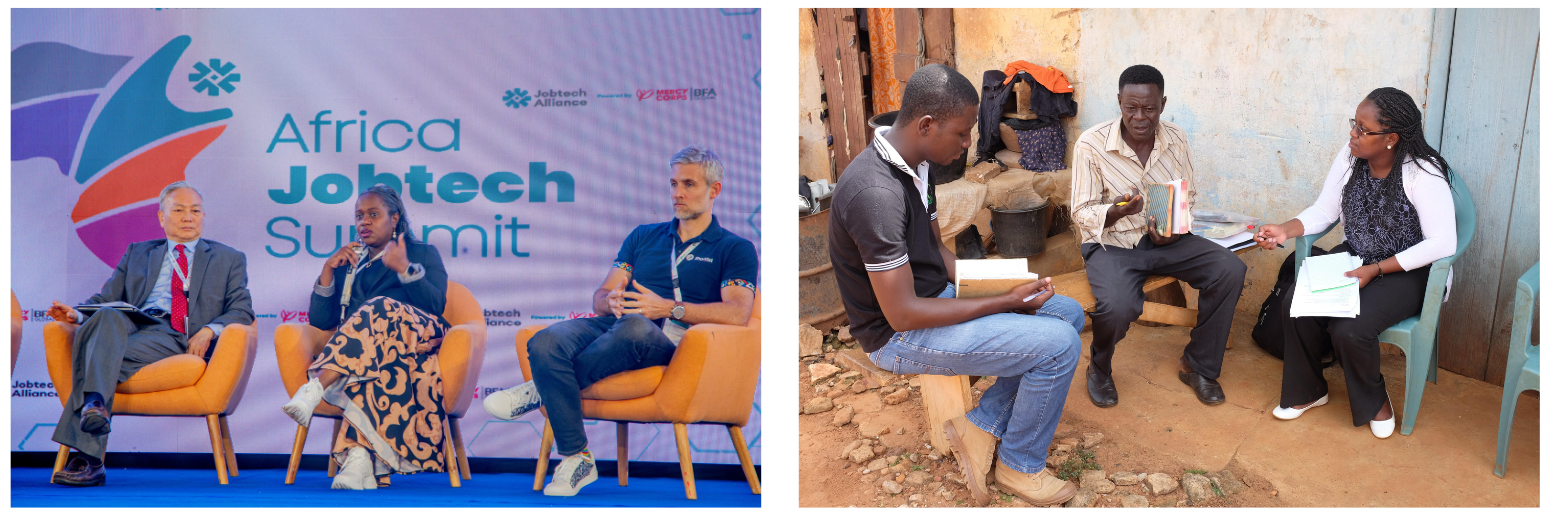
Jobtech Alliance is a perfect example. Our partnership with Mercy Corps, now Prosper Global, has shown me what happens when organizations bring their strengths together, trust one another, and share a vision of what they want to achieve. Through the Alliance, we’ve worked together to build an ecosystem in a sector that’s very critical to job creation. There are 10-12 million youth entering the labor market, but only 3 million jobs, so we need to find ways to create work for youth in Africa. That experience has shown me that the best partnerships aren’t simply about dividing responsibilities. They’re about combining what each organization does best to achieve meaningful impact.
And perhaps my favorite part? Getting to do work that genuinely matters with people who make the journey fun. (Hey Chris! Jacob! Nick! Phoebe! Anne! Shirley!) A great partnership isn’t just about complementary capabilities. It’s also about the people you get to build something with.
Lesson 2: Listen to the people you’re designing for
Some of my most valuable lessons came from sitting with people in their homes, listening to their stories, and understanding how they actually live.
Working with Julie Zollmann particularly reinforced how much we can learn when we take the time to listen. Our work on the Kenya financial diaries is a reminder that behind every data point is a real person making difficult decisions. It also taught me how easily we can make assumptions about what people need when we’re designing from a distance. Spending time with people, understanding the trade-offs they make and seeing the realities behind the data can completely change how you understand a problem and, ultimately, the solution you design.
Eleven years later, whether I’m working with a financial institution or supporting a jobtech venture, I still believe the best solutions start with listening.
And a little plug for Julie: subscribe to her Substack to follow her latest insights from people’s lived experiences in the health diaries.
Lesson 3: Gender inclusion doesn’t happen by accident
We talk a lot about reaching underserved communities, but I’ve learned that good intentions are never enough.
If we want products and services to work for women, we have to intentionally design for them. That means understanding their time constraints, safety concerns, access to finance, social norms, and opportunities.
Through our work with financial institutions, entrepreneurs, and the Jobtech Alliance, I’ve seen how much changes when women are considered from the beginning rather than added as an afterthought. It changes the questions we ask, how products and programs are designed and delivered, and the barriers we prioritize solving. Something as fundamental as when and where a service is available, how someone pays for or accesses it, or whether they can use it safely can determine whether women are able to participate at all. BFA Global wrote about this several years ago in the report “A Buck Short,” and more recently, in a new framework for Enabling Low-Income Women to Increase Their Incomes.
Lesson 4: Work with cool people, and keep them in your life
One of the greatest gifts BFA has given me is the people I’ve met along the way.
I remember being out in the field with Dan Waldron in rural Uganda and Ghana, learning about people’s lives and trying to make sense of what we were seeing. Today, Dan leads insights at Acumen and remains just as passionate about ensuring that people’s voices are heard. Then there’s Lorraine Charles, with whom I’ve worked to explore how refugees can earn a living through digital jobs and build evidence that these opportunities are possible.
I’ve worked with brilliant people who have challenged my thinking, made me laugh and eventually become lifelong friends. I could probably write an entire book about the people I’ve met and the experiences we’ve shared! Some have moved on to other organizations and countries, but the relationships and shared passion for impact have remained.
Eleven years later, I’ve learned that the people you work with can be just as important as the work itself.
Lesson 5: Sometimes you have to get your hands dirty to create impact
Producing a great report is one thing, but helping entrepreneurs turn insights into real businesses is another.
Over the years, I’ve learned that some of the most meaningful work happens after the research is done and the recommendations have been made. It’s in working alongside entrepreneurs as they test assumptions, talk to customers, rethink what isn’t working, and figure out how to build something that people will actually use and pay for.
This could be about getting into the messy reality of building businesses, experimenting with ideas, changing business models, and celebrating small wins. The process is rarely linear, but getting close enough to the work to understand what’s actually happening is often where the real learning and the opportunity for impact begin. BFA Global has perfected this with our venture-building approach.
Lesson 6: If you want to go far, build an ecosystem and drive systems change
One thing we’ve always believed at BFA is that meaningful and lasting impact doesn’t happen in isolation. If we want to tackle complex challenges, we need to think beyond individual projects and organizations and focus on changing the systems in which they operate.
From the early days of Catalyst Fund, where we brought together different players to support fintech innovation, to the CIFAR Alliance, where we helped build a community around climate resilience, and now the Jobtech Alliance, we’ve consistently believed in the power of building ecosystems to drive systems change.
Through Jobtech Alliance, I’ve seen firsthand what happens when you bring together ventures, investors, funders, policymakers and other ecosystem players around a shared vision. It’s not just about supporting individual companies or delivering successful programs. It’s about addressing the barriers that hold an entire sector back, building connections, influencing how resources flow and creating the conditions for more players to succeed.
And that’s what systems change means to me. It’s moving beyond the impact of our individual interventions to changing how the broader ecosystem works, so that progress can continue and grow long after our programs end.
The lesson? Stop thinking only about what your organization can achieve alone. Start thinking about what everyone can achieve together, and how you can change the system to make that impact last.
Lesson 7: Don’t fall in love with technology. Fall in love with the problem
I’ve so far worked with banks, financial institutions, and ventures across fintech, climate, and jobtech. And one thing I’ve learned is that we often rush toward technology when the solution doesn’t necessarily need to be sophisticated.
Sometimes, WhatsApp, Telegram, or even a simple offline process is exactly what people need.
Working across different sectors has reinforced the importance of understanding the problem before designing the solution. Technology should be an enabler, not the starting point. That means spending enough time understanding how people currently solve a problem, what isn’t working for them, and what would actually make their lives easier before deciding what to build. Sometimes that leads to sophisticated technology. Sometimes it leads to something much simpler.
I’ve seen how easy it is to get excited about a new platform or innovation without asking whether people can actually use it or whether it addresses their everyday challenges.
Innovation isn’t about how impressive the technology looks. It’s about whether it solves a real problem, reaches the people who need it and improves their lives.
Lesson 8: Leadership is about creating space for others to grow
I’ve been incredibly fortunate to grow professionally at BFA, and one of the most important things I’ve learned is that leadership comes with a responsibility to create those same opportunities for others.
Over the years, I’ve managed and worked alongside some truly impressive people who have taught me just as much as I’ve hopefully taught them.
From learning how to collect data and engage with users to thinking about ecosystems, systems change, and organizational leadership, so much of my own growth has come from the people around me.
I’ve also learned to delegate, trust others to lead, and give people the space to experiment, make mistakes, and discover what they’re capable of.
One of the most rewarding parts of leadership is watching someone you’ve worked with grow into a role, take ownership of an idea, or achieve something they didn’t initially think was possible.
Lesson 9: Everyone talks about impact. But what’s the business model?
Throughout my time at BFA, I’ve worked across different programs, sectors, and business models. And one question has consistently come up: how do we balance impact with financial sustainability?
This is particularly important in our venture-building work. We don’t want to support companies that thrive only while receiving funding or technical assistance. We want to help build businesses that can continue to grow, generate revenue, and create impact long after our support ends.
The same applies to our own organizations. How do we continue doing meaningful work, pay our people fairly, invest in innovation, and remain financially sustainable?
As we navigate an increasingly uncertain development sector, I think this question has become even more important.
We need to challenge ourselves to rethink traditional funding models, diversify revenue streams, and explore new ways of financing impact.
Impact without a sustainable business model is difficult to sustain. The challenge is building models that allow us to create more impact, not less.
Lesson 10: Get comfortable with being uncomfortable
If you’d asked me 11 years ago whether I’d be doing what I’m doing today, I probably would have said no!
I still remember my first assignment at BFA: a research project in Tonga. At the time, I didn’t even know how to get there!
Since then, my work has taken me to countries I never imagined visiting and into sectors I knew very little about when I started.
From financial inclusion to investment, climate finance, venture building and jobtech, I’ve repeatedly found myself having to learn something completely new, often while already working on it.
And that’s not always comfortable.
Sometimes you have to lead even when you don’t have all the answers. You have to be willing to ask questions, surround yourself with people who know more than you do and accept that learning is part of the process.
Looking back, some of my biggest professional growth has come from opportunities I initially felt unprepared for.
Lesson 11: Never stop reinventing yourself
Over the last 11 years, my role and the work I’ve taken on have evolved in ways I never could have predicted. I’ve worked across research, financial inclusion, investment, venture building, and ecosystem development. I’ve had the opportunity to work with incredible people, build lasting friendships, and take on responsibilities I never imagined when I first started.
I’ve worked in the investment space without being an investor, helped build ventures without being an entrepreneur myself, and supported the growth of entire ecosystems.
And now, 11 years later, I’m part of conversations about what the future of BFA itself could look like.
It’s interesting to reflect on how much I’ve changed over that time, both professionally and personally.
One of the things I’ve appreciated most about BFA is having the opportunity to evolve without necessarily having to leave. To try something different, take on new challenges, and continuously discover new interests and capabilities.
And I’m certainly not done learning or reinventing myself. I’m grateful for the people, experiences, and opportunities that have shaped these 11 years, and excited to see what comes next. If the last 11 years have taught me anything, it’s to stay curious, keep learning, and remain open to where the journey takes me.