Designing incentives for last-mile retailers: Lessons from Victory Farms
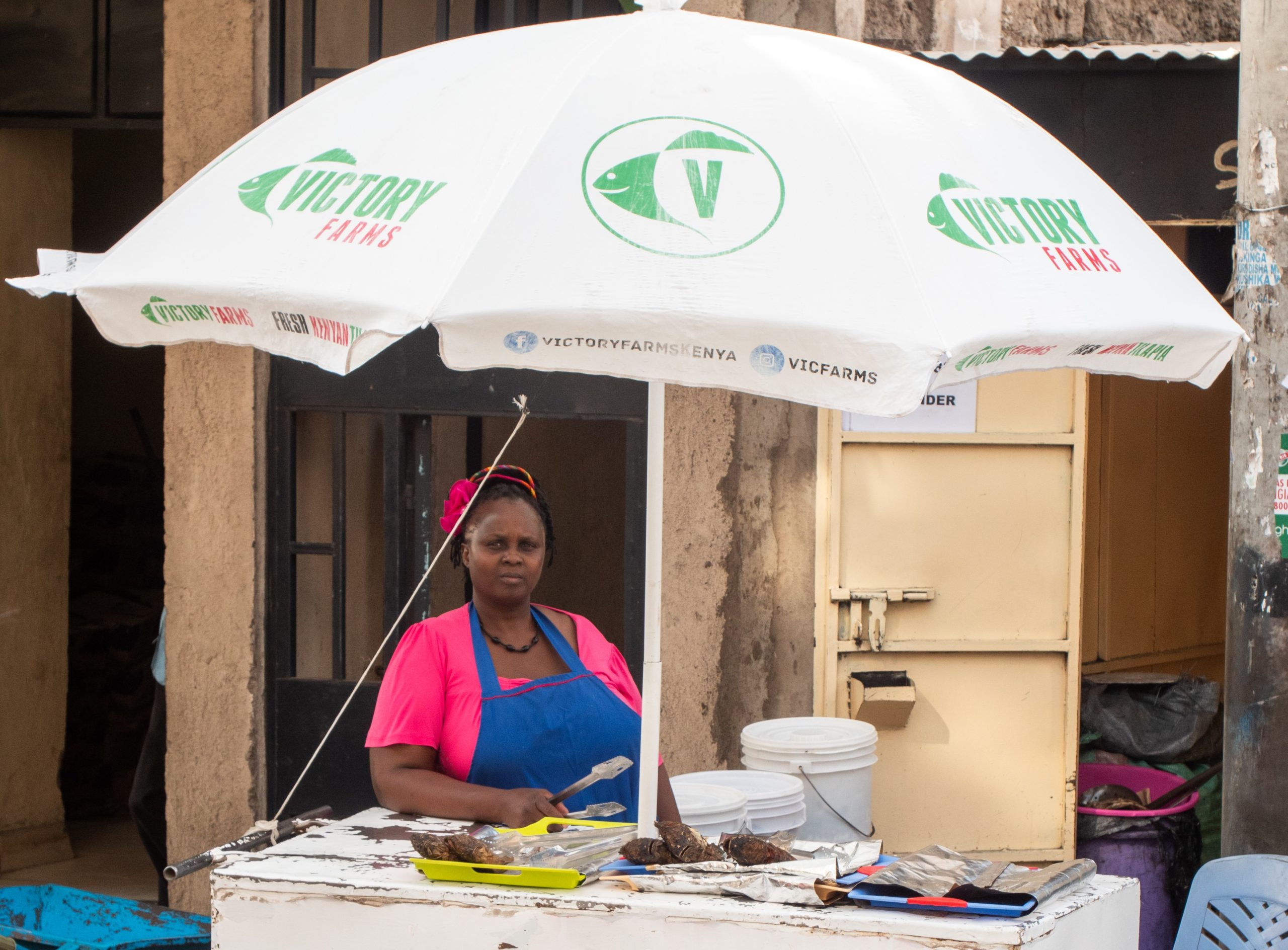
It’s noon, and a long day at the fish market begins. Customers queue at their favorite stalls run by women fish sellers known as Mama Samaki – the heart of Kenya’s last-mile fish distribution network. To an observer, these businesses appear to be running smoothly. But beneath the surface, they depend on a delicate balance of supply and demand. Frequent supply delays, inconsistent fish quality, and long distances to procurement points make them fragile and highly vulnerable to disruption.
Victory Farms, a tilapia farming company, is an established player in Kenya’s fish supply market. Through its vertically integrated model and extensive distribution network, the company delivers to over 15,000 Mama Samaki, providing a reliable, accessible, and consistently high-quality fish supply to traders.
To help Mama Samaki address key business challenges, such as attracting and retaining customers, managing fluctuating demand, and making informed financial decisions, Victory Farms introduced the Market Women Program. The program offers an integrated set of interventions for women just entering the fish-selling business (Dada Samaki) and those operating at lower levels (Mwanzo) to set up viable businesses and increase their incomes:
- A points-based loyalty program rewarding consistent purchasing with essential business tools, such as umbrellas, solar lights, and cooking oil
- Mentorship and starter kits for new entrants (Dada Samaki)
- Structured training on customer management, pricing, and financial planning
- A short-term loan through a third-party provider to enable stock purchases on credit
BFA Global partnered with Victory Farms through the Opportunity Leads Umbrella Fund project to strengthen the design and delivery of these interventions. Part 1 of this two-part blog series explored these interventions in detail. Part 2 assesses the impact of the loyalty program, starter kits, and training, and examines what drives sustained sales and loyalty among Mama Samaki.
Our findings indicate that these interventions have helped Mama Samakis build more resilient enterprises. The training has built their capabilities, starter kits have lowered entry barriers, and loyalty programs have encouraged repeat purchasing. However, the effectiveness of the interventions depends heavily on the strength of the underlying operational and supply model. While these incentives build trust and enable participation, they cannot offset barriers related to access, logistics, and procurement.
Impact on sales
The pilot ran from January to October 2025, starting with business skills training for 709 participants. This was followed by enrollment in the loyalty program for the Mwanzo and the provision of starter kits for Dada Samaki. By April, both the training and onboarding were complete. To assess impact, we compared fish purchase patterns across test and control groups between April and September 2024 and during the same period in 2025. The test group included all Mama Samaki who participated in the pilot, while the control group consisted of similar traders who did not.
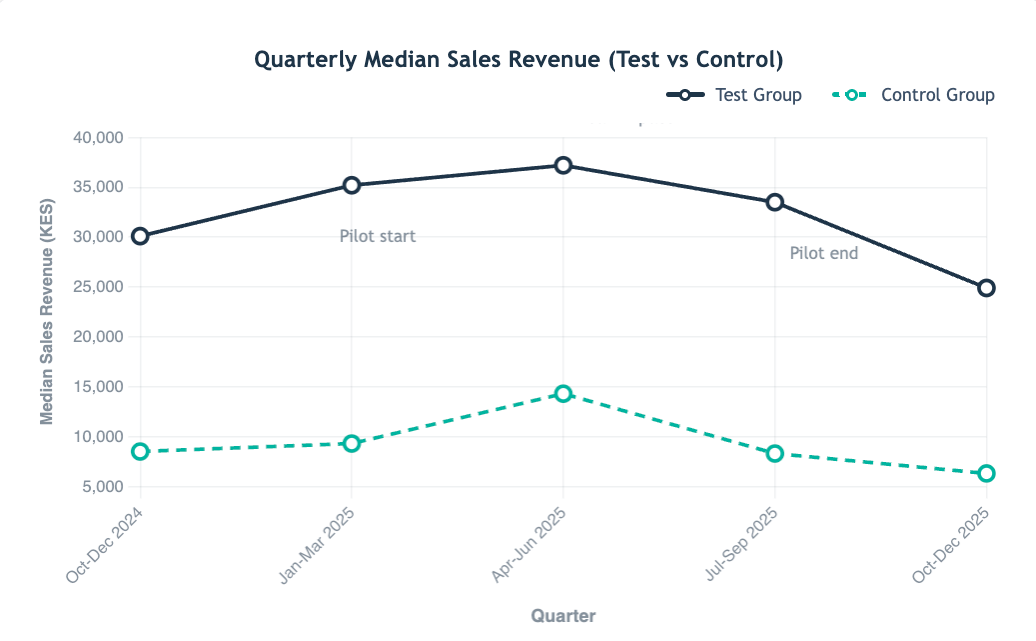
Median sales revenue shows a clear and sustained advantage for the test group, with relatively stable performance compared to the control group. Before the pilot (October–December 2024), the test group’s revenue (KES 30,227) was already about 3.6 times higher than the control group’s (KES 8,440). During the pilot, the test group saw moderate but steady growth (over 16% in January–March 2025 and over 6% in April–June 2025), followed by a moderate decline in July-September (10%). In contrast, the control group fluctuated sharply, with a spike (over 54% in April–June 2025) followed by a steep drop (41%) after June, suggesting less consistent performance throughout the year.
In June 2025, Victory Farms introduced changes to its procurement model, encouraging traders to buy directly from warehouses while outlets shifted to retail pricing. For many small- and mid-scale traders operating on thin margins, increased transport costs alone could account for a third or even all of their daily profits.
While all traders were affected, those in the Market Women Program were better able to absorb the disruption and maintain relatively stable purchasing. In contrast, traders in the control group experienced a sharper decline and remained at lower levels through September.
By the end of the pilot (October–December 2025), both groups showed declines and began to perform more in line with each other. This confirmed that the earlier divergence was due to the intervention. Overall, participation in the program helped traders withstand operational shocks more effectively. At the same time, it shows that while incentives can drive early gains, their impact is ultimately shaped, and often constrained, by the strength of the underlying operational system.
Comparing the effectiveness of incentives
-
A points-based loyalty program is valuable, but more trust and long-term engagement are needed.
Victory Farms introduced a points-based loyalty program to encourage consistent purchasing among Mama Samaki, rewarding purchases with practical assets to support their business, such as umbrellas, solar lights, cooking oil, and more. Given that the program was still in early stages, overall redemption remained relatively low, with only about 18% of eligible customers redeeming rewards.
Cooking oil, at just 60 points, was the most redeemed item, followed by mid-tier items such as parasols and frying pans. In contrast, higher-value items, such as trolleys, were rarely redeemed. This pattern likely reflects a preference for immediate, practical benefits rather than accumulating points for larger purchases. It may also indicate that some users are saving for higher-value rewards, given the program’s early stage.
The loyalty program generated goodwill, especially by reducing day-to-day business expenses. While most users did not report a direct increase in income from the rewards, many highlighted how these benefits eased immediate cost pressures. One woman in Nairobi shared that receiving a solar lantern “allowed me to extend my working hours into the evening.” Another explained that receiving 10 liters of cooking oil meant she did not need to purchase oil for an entire week, helping her save on a key input cost.
This is especially important given how women entrepreneurs tend to manage money. Many prioritize household needs over reinvesting in their business, which means the loyalty program acts as a buffer, allowing women to access essential inputs like cooking oil even when cash is being spent elsewhere. This makes the program valuable, particularly for sustaining day-to-day operations. Over time, these savings may translate into clearer income gains.
A broader insight also stood out: loyalty is not experienced as a points-based system but as a relationship with Victory Farms. Mama Samaki describes their loyalty in terms of how long they have been associated with the company (“I have been with them since 2023“) and whether they feel recognized (“They called me to participate“). This relationship is shaped by how well the business delivers on its core value proposition. While rewards are valued and remembered, incentives alone are not enough to sustain engagement. Only when price, quality, and supply are reliable can the loyalty program meaningfully differentiate the offering and create additional value. But if these fundamentals weaken, the program cannot compensate.
From a business perspective, this has implications for sustainability. While the program rewards actual purchases, the cost of rewards is borne by the business. If customers disengage after redemption, the value is not fully realized, and the program is unlikely to sustain itself. For Victory Farms to fully benefit from stronger customer retention and sustained engagement, it should shift from offering high-cost rewards to features that directly support day-to-day operations, such as priority access to stock, SMS alerts on availability, and targeted discounts. These might also be less costly for Victory Farms to provide.
-
Starter kits and mentorship lower entry barriers, but conversion remains low.
Starter kits, combined with mentorship, were one of the most direct ways to reduce barriers to entry for women interested in starting fish-selling businesses. Victory Farms introduced a mentorship-plus-graduation model in which new entrants (Dada Samaki) first undergo job shadowing with experienced sellers to gain practical exposure to day-to-day operations, customer management, and core business skills. They are then offered discounted starter kits, such as cooking oil, frying pans, lanterns, and parasols, which can be borrowed and repaid with loyalty points.
Most Dada Samaki previously worked as casual helpers for larger sellers, earning very little and unable to save enough to start their own businesses. For these women, access to basic equipment removes a key barrier to entry. The combination of classroom training and job shadowing also helped them use these assets effectively and build confidence. Those who started a business said they would never have done so without Victory Farms’ support. As one woman shared, “Victory Farms gave me a frying pan and a spoon, and I just began cooking.”
However, conversion from training to business creation remains low. Among those interviewed, two out of four Dada Samaki in Nairobi and two out of nine in the Western region had started new businesses. While the starter kits played an important role, they were often not sufficient on their own. Some women noted that they still needed additional equipment, such as umbrellas and chairs, as well as working capital to purchase stock.
For many others, the barrier was not just capital, but readiness. About half of those interviewed continued working in family businesses – supporting mothers, sisters, or grandmothers – and felt comfortable in these roles given their current personal and financial circumstances. Starting their own business remained a longer-term aspiration, dependent on access to capital and a suitable location. Some Dada Samaki had already started businesses prior to the program, using borrowed or rented equipment. For them, receiving starter kits increased independence and control over their operations.
While starter kits reduce entry barriers, they do not address factors such as readiness, risk appetite, and opportunity cost, which play an equally important role in determining whether women start businesses.
From a business perspective, the starter kit model is expensive. Key equipment, such as woks and parasols, can cost between KES 1,500 and 1,800, and participants have limited commitment to repay the loans. While the impact of this intervention is significant for those who start a business, sustaining such a model at scale is likely to be costly and may not deliver proportional returns for the supplier.
-
Training builds skills, confidence, and control, but offers limited immediate returns for the provider.
Training was described as practical and immediately applicable to the realities of urban fish trading, influencing how Mama Samaki managed their day-to-day businesses. Women described applying lessons in customer care, hygiene, and presentation, and making more deliberate decisions about pricing and stock. Sessions that focused on customer handling and communication skills were particularly relevant when explaining price changes, justifying quality, and managing skeptical customers. As one trader explained, “We were taught how to talk to customers… so they do not feel you have exploited them.” Others highlighted the importance of presentation: “I [now] arrange the fish well to attract customers to buy.”
More importantly, training shifted how women thought about money. Many described moving from intuitive selling to more deliberate calculation. As one Mama Samaki put it, “Before, I would just sell… now I calculate how much I bought and how much I should sell to make a profit.” Training also strengthened confidence and identity. Women reported feeling more disciplined, more consistent, and less intimidated when dealing with customers. One trader put it simply: “I am a businesswoman… a fish businesswoman.”
Despite these gains, the financial impact of training was uneven. At the time of the interviews, improved skills had not yet translated into increased income for most women. From a delivery perspective, training also had trade-offs. Although women prefer in-person sessions for learning practical skills, these are more expensive. Digital training reaches more women at a lower cost but is often disrupted by poor internet access or lost phones.
This raises questions about sustainability. While training creates clear value for women, it is unlikely to be sustained at scale by the supplier alone. A more viable approach may be to share the responsibility with partners who directly benefit from specific outcomes, for example, financial services providers supporting financial management training. Without such partnerships, it is unlikely that Victory Farms can continue to deliver training at scale on its own.
Ongoing challenges and trade-offs
-
Incentives build trust, but a predictable supply is the backbone of these businesses.
While the findings highlight the value of incentives, much of the impact is long-term and largely qualitative, with limited evidence of immediate commercial returns. More importantly, the impact is limited by underlying operational issues.
A key issue is predictability. For Mama Samaki, income depends heavily on stable access to fish, both in terms of price and availability. When prices fluctuate or supply becomes inconsistent, traders are unable to plan purchases, manage margins, or meet customer expectations. This makes incomes volatile and weakens trust, regardless of the incentives offered. While Victory Farms’ model is designed to create a more reliable supply, recent shifts in procurement and pricing have introduced new challenges and uncertainties at the last mile.
The move toward warehouse-based purchasing has put particular pressure on traders. Higher minimum purchase requirements, increased transport costs, and reduced flexibility have disrupted buying patterns. For small traders operating on thin margins, this has translated into higher working capital needs and lower profits, pushing some to shift to competitors or alternative markets like Gikomba. While selling at branches remained ongoing and customers could still access fish through that channel, revisiting procurement design, such as complementing the warehouse with branch sales, enabling smaller or mixed-size purchases, or offering more flexible pick-up options, may help further reduce this pressure.”
These dynamics also shape which interventions are worth sustaining. The loyalty program shows potential to sustain itself over time, as it is directly linked to purchases and can improve retention when aligned with core business value. In contrast, training and starter kits, while impactful, are costly to provide and do not generate immediate returns. This suggests that Victory Farms may need to redesign its interventions to better align with business outcomes or limit its role to targeted, partner-supported efforts.
Conclusion
The experience of Victory Farms highlights a clear lesson: incentives can enable participation and build trust, but they cannot compensate for gaps in the underlying system.
When procurement, pricing, and supply are predictable, loyalty programs can reinforce engagement and create additional value for traders. However, when these fundamentals are disrupted, even well-designed interventions struggle to have an impact over time. For businesses operating through last-mile informal retailers, this has important implications. Investments in incentives should be closely tied to the strength of the core value proposition. Where operational challenges persist, the priority should be improving system reliability rather than expanding incentive-based programs.
There is also a clear trade-off between the cost of these interventions and the value they generate for the business. While lower-cost incentives, such as loyalty programs, show promise for sustaining engagement, more costly interventions may offer limited returns and be harder to sustain at scale.
In this sense, operational efficiency is not just an enabler but the foundation. Incentives can strengthen the system, but they cannot replace it.